





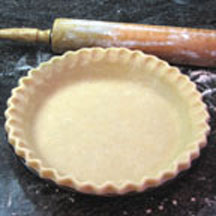
This pie crust recipe has
been used for years...always with success. You too, can become
the 'Pie-Baker' within your circle of family and friends.
Basic
Pie Crust 101
- 1 1/3 cup all-purpose
flour
- 1/2 cup Crisco vegetable
shortening, plain or butter-flavored*
- 1/2 teaspoon kosher or
sea salt
- 3 tablespoons ice-cold
water
- Combine flour and salt
in mixing bowl. Cut
shortening into the flour with a pastry cutter, until mixture
resembles the texture of tiny split peas. Do not use your hands to try and mix it, the heat
from you hands will
melt the shortening, causing the pastry to be "heavy",
not light and flaky.
- Once mixture is the right
texture, add the ice water and combine
with a fork. It may appear as if it needs more water,
it does not. Quickly gather the dough into a
ball and flatten into a 4-inch-wide disk. Wrap in plastic, and
refrigerate at least 30 minutes.
- Remove dough disk from
refrigerator. If stiff and very cold, let stand until dough is
cool but malleable.
- Using a floured rolling
pin, roll dough disk on a lightly floured surface from the center
out in each direction, forming a 12-inch circle.
- To transfer dough, carefully
roll it around the rolling pin, lift and unroll dough, centering
it in an ungreased 9-inch regular or deep-dish pie plate. (Or
you can fold dough in quarters, then place dough point in center
of pie pan and unfold dough, whatever is easiest for you.)
- For a Recipe Using an
Unbaked Crust: Proceed as directed.
- For a Recipe Using a Single
Baked Crust: Prick dough thoroughly on the bottom and sides with
the tines of a fork to help prevent it from blistering and "puffing
up" as it bakes. Bake at 425°F
(220°C) for about
15 to 18 minutes, or until light golden brown. Cool before filling.
Proceed with recipe's directions.
Makes 1 (9-inch) pie crust.
(Double recipe for a two-crust pie.)
*During winter
months, flour can become "drier", you may need to add
more water, about 1 teaspoon or so per single recipe, but not
much more.
Nutritional Information
Per Serving (1/8 of recipe.): 188.9 calories; 60% calories from
fat; 13.0g total fat; 0.0mg cholesterol; 118.0mg sodium; 22.2mg
potassium; 15.9g carbohydrates; 0.6g fiber; 0.1g sugar; 15.3g
net carbs; 2.1g protein.
Copyright Hope
Pryor,
please see Terms
of Use.
Photograph property of CooksRecipes.com.
loading
Click
here for the print-out page for "A Pie Baker's Helpful Pie
Tips".
A Pie
Baker's Helpful Pie Tips
Assorted Pie Assembly Directions:
- For Baked Pie Crust
(also referred to as Baking Blind): Place rolled-out pastry in pie plate, gently press
against bottom and sides of pan. Trim overhanging edge of pastry
about 1-inch from the pie
plate's edge. Tuck this rim of dough underneath itself so that
folded edge is flush with pan edge. Flute the edge. Prick crust
thoroughly on the bottom and sides with the tines of a fork to
help prevent the dough from blistering and "puffing up"
as it bakes. Or, you can line the unbaked
pastry shell with foil or parchment paper, fill with dried beans
or rice, clean pebbles (a French practice) or specialty pie weights
made of metal or ceramic. The weights and foil or parchment paper
should be removed a few minutes before the baking time is over
to allow the crust to brown evenly. Bake at 425°F (220°C) for about 15 to 18 minutes, or
until light golden brown. Cool before filling. Proceed with recipe's
directions.
- For Unbaked One-Crust
Pie Shell: Place
rolled-out pastry in pie plate, gently press against bottom and
sides of pan. Trim overhanging edge of pastry about 1-inch from the pie plate's edge. Tuck this
rim of dough underneath itself so that folded edge is flush with
pan edge. Flute the edge. (Do not prick the crust before filling or it will
seep under the crust during baking.) Refrigerate while preparing
filling. Pour filling in chilled pie shell and proceed with recipe
directions for baking.
- For Unbaked Two-Crusted
Pie: Double recipe
above. Place rolled-out pastry in pie plate and gently press
dough into sides of pan, leaving portion that overhangs edge
of pie plate in place. Refrigerate while preparing filling. Turn
in the desired filling. Moisten the edge of the pastry with water,
then carefully place top crust over filling. Trim top and bottom
edges to 1-inch beyond pan edge. Tuck this rim of dough underneath
itself so that folded edge is flush with pan edge. Flute edging
or press with fork tines to seal. Vent the top crust by pricking
with the tines of a fork or making slits with a sharp knife in
several places. (This allows steam to escape during baking.) Proceed
with recipe directions for baking.
Assorted Pie Tops:
- For a Lattice-Top:
Prepare pastry for a two-crust
pie, leaving 1-inch overhang on bottom crust. After rolling circle
for top crust, cut into strips about 1/2-inch wide. (Use a pastry
wheel for decorative strips.) Place
5 to 7 strips (depending on size of pie) across filling in pie
plate. Weave a cross-strip through center by first folding back
every other strip going the other way. Continue weaving until
lattice is complete, folding back alternate strips each time
cross-strip is added. (Or, to save time, do not weave strips.
Simply lay second half of strips across first strips.) Trim ends
of strips. (Strips can be twisted as they are placed on pie,
if desired.) Fold trimmed
edge of lower crust over ends of strips, building up a high edge.
Seal and flute. Proceed with recipe directions.
- For a Diamond Top:
Lay or weave second half of
pastry strips diagonally across first strips on filling.
- For a Spiral Top:
Begin from center of pie.
Twist one strip and coil it outward on pie, adding length by
moistening ends of other strips and pinching together. Moisten
trimmed edge of bottom crust; place tightly twisted pastry strip
around edge, pressing to seal.
- Fluting the Edge:
- For a Cutout Edge:
Trim overhang even
or flatten pastry on rim. use tiny cookie cutter, thimble or
hand-cut tiny leaves, hearts, circles, etc., from pastry scraps.
Moisten rim and place cutouts around rim, overlapping if desired.
Press into place.
- For a Fork Edge: Flatten pastry evenly on rim of
pie plate. Press firmly around with tines of a fork. To prevent
sticking, dip fork in flour.
- For a Pinch Edge: Place index finger on inside of
pastry rim and knuckles (or thumb and index finger) on outside.
Reverse the position if it is more comfortable. Pinch pastry
into V-shape along entire edge. Pinch again to sharpen.
- For a Rope Edge: Place side of thumb on pastry
rim at an angle. Pinch pastry by pressing the knuckle of your
index finger down into pastry toward thumb.
Pastry Tips for Success:
- Always use of a quality brand of vegetable
shortening is very important for a successful pie crust that
is tender and flaky. My personal preference is the brand, Crisco.
- A pastry blender is a
great help to cut in shortening evenly. If you don't own one,
purchase one! It's the "cutting in" of the shortening
into tiny lumps that gives pastry its flaky texture.
- If your hands are unusually
warm, then "cool" them off with a couple of ice cubes and then drying
thoroughly before handling
the dough. The cooler the dough during preparation, the flakier
the crust.
- Anchor a pastry cloth
around a board with tape and use a cloth cover for your rolling
pin to keep the dough from sticking. Rub flour into both; this
will prevent sticking, yet the flour won't be absorbed by the
dough.
- Due to the amount of fat
in pastry and crusts, pie plates or pans are not usually greased.
- Nonstick pie pans can
cause pastry to shrink excessively when baking one-crust pie
shells. Be sure pastry is securely hooked over the edge of a
nonstick pan.
- Do not stretch
the dough to fit the pie pan, it will
shrink from the edge if you do. Make sure
to roll it out at least 1-inch larger than the pie pan.
- Do not overwork the dough,
less handling makes a more tender and flaky crust.
- For pumpkin and custard
pies, brush beaten egg over unbaked pastry shell before filling.
This helps prevent the crust from becoming soggy.
- A pair of kitchen scissors
makes the best tool to evenly trim the overhanging edge of the
pastry before folding under and fluting.
- Brushing the top crust
with slightly beaten egg white will give it a glazed look.
- Brushing the top with
milk will give a shiny appearance.
- Sprinkling the top crust
with granulated or turbinado (raw) sugar will give a delightful
sparkling appearance.
- Cutting designs such as
apples and leaves out
of excess dough and "gluing" them onto the unbaked
pastry by moistening the underside of the cut-out, makes another
lovely decoration for your "masterpiece".
Copyright Hope Pryor, please see Terms of Use.
|